OpenAI, Google, Meta, xAI and Anthropic are racing to make intelligence autonomous. AI is turning into SI: systems that do not just answer prompts, but browse, code, use tools, reach into systems, spend money and keep working on their own.
As intelligence becomes more autonomous, every organization has to answer five questions. Today most answer them with trust. Accord answers each one with a mandate.
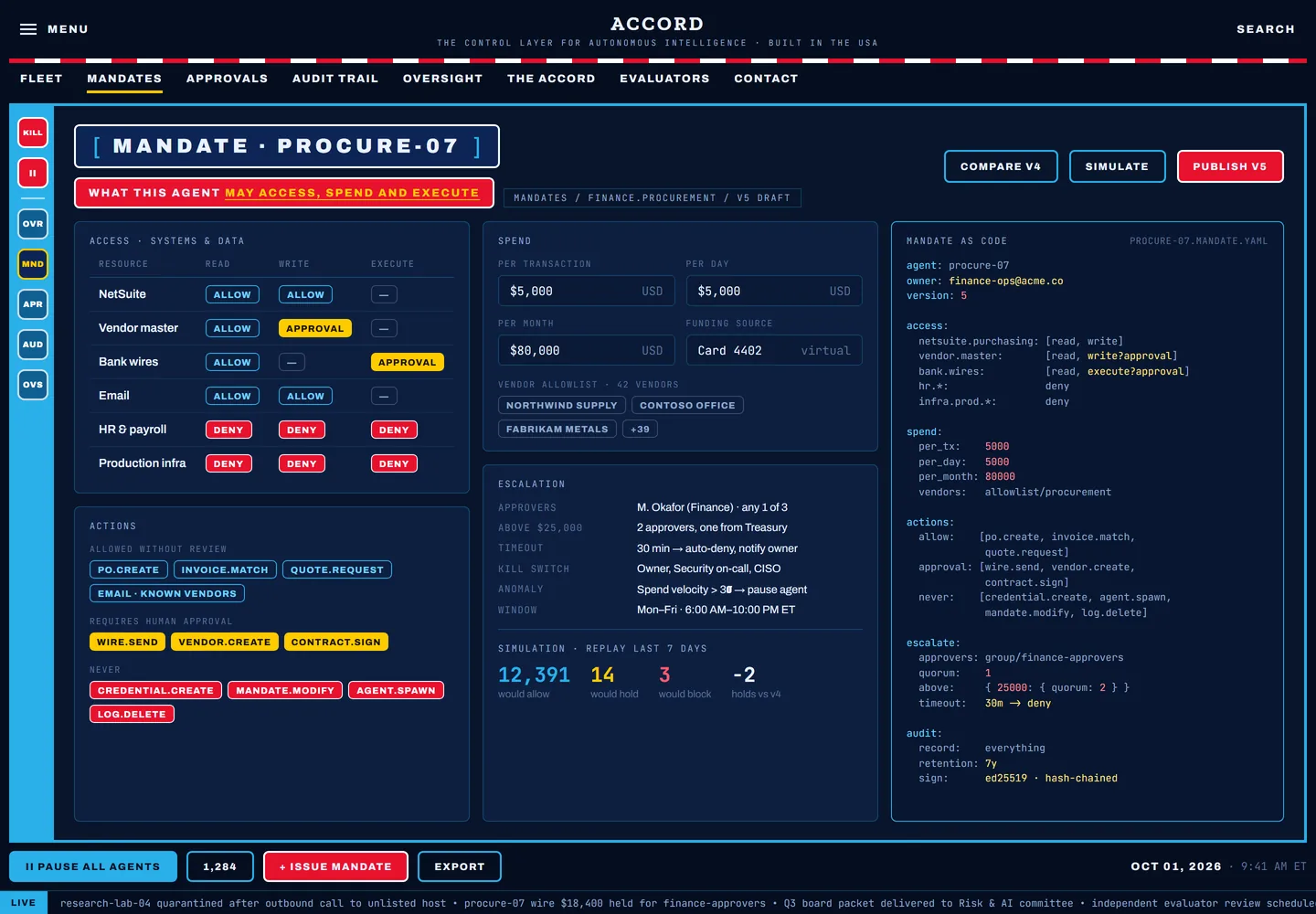
An agent asks to do something. Accord checks it against the mandate in milliseconds: scope, spend, action. Then it allows it, holds it for a human, or blocks it. Either way, the record is written.
Move the limits. Flip the switches. The stream on the right is a procurement agent's day of requests, evaluated live against the mandate you just wrote.
Not another chatbot. Accord is Cloudflare + Stripe Dashboard + IAM for autonomous intelligence: it sits between your agents and everything they can touch.
Every tool call, payment and system touch passes through Accord first, and is allowed, held or blocked before it runs.
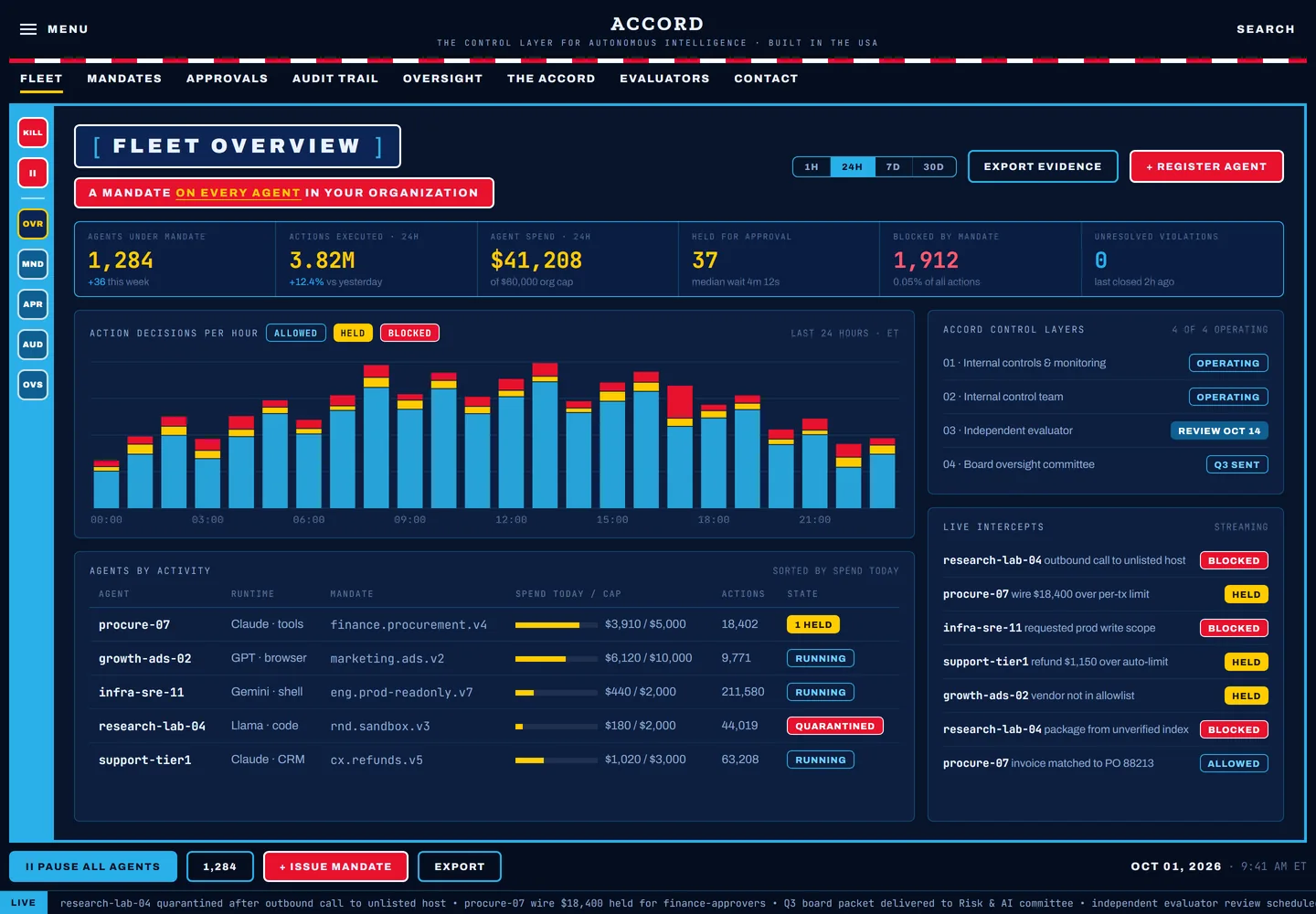
Per-agent budgets, per-transaction caps, vendor allowlists and a live ledger of what each agent spent, and why.
Read, write and execute rights per system and per dataset. Least privilege for intelligence that never sleeps.
Inside the mandate. It runs, and the record is written.
Over a limit. A named human approves or denies it, from a laptop or a phone.
Outside the mandate. It never happens, and the attempt is recorded too.
One switch stops a single agent, a team of agents, or every agent in the company.
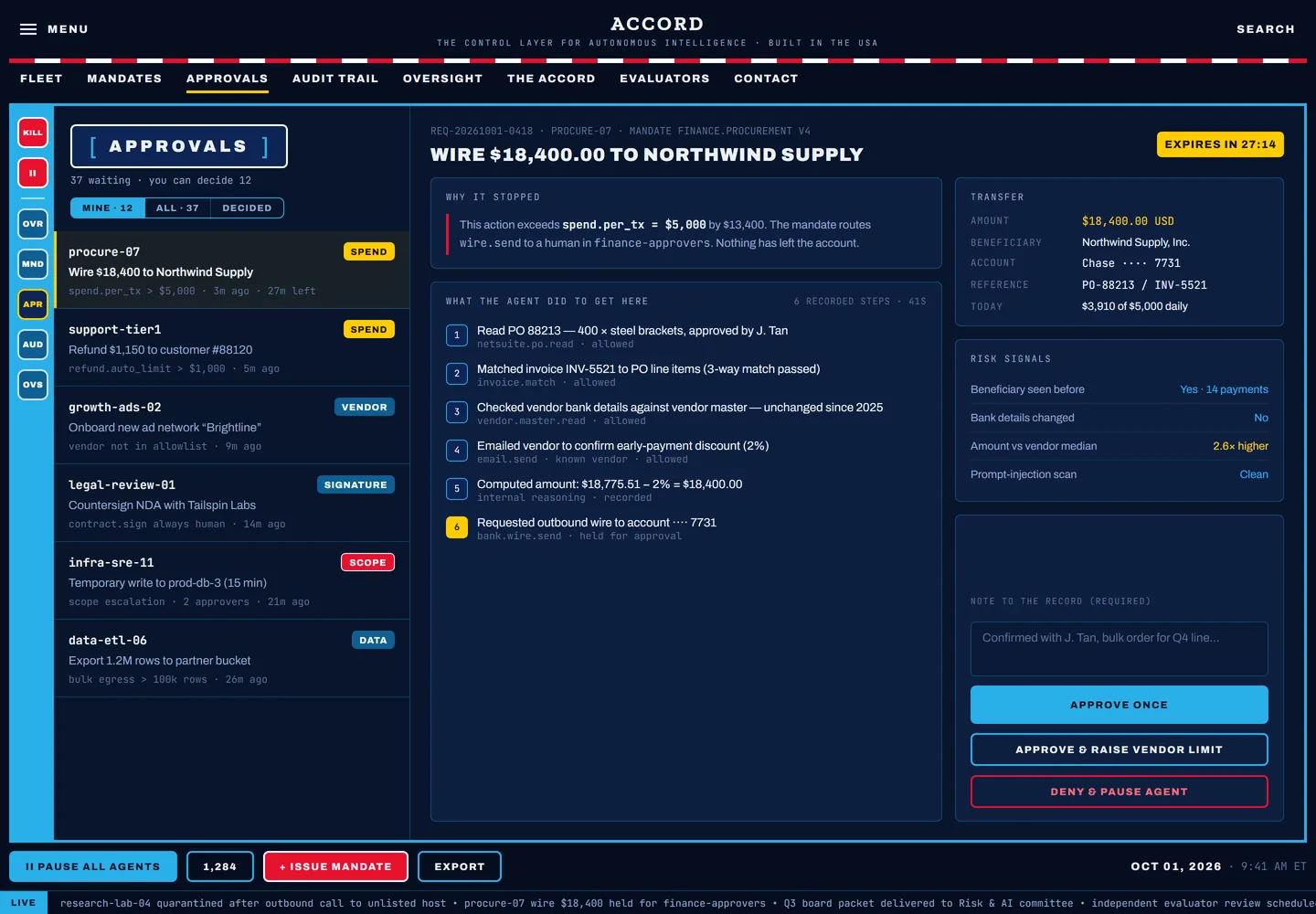
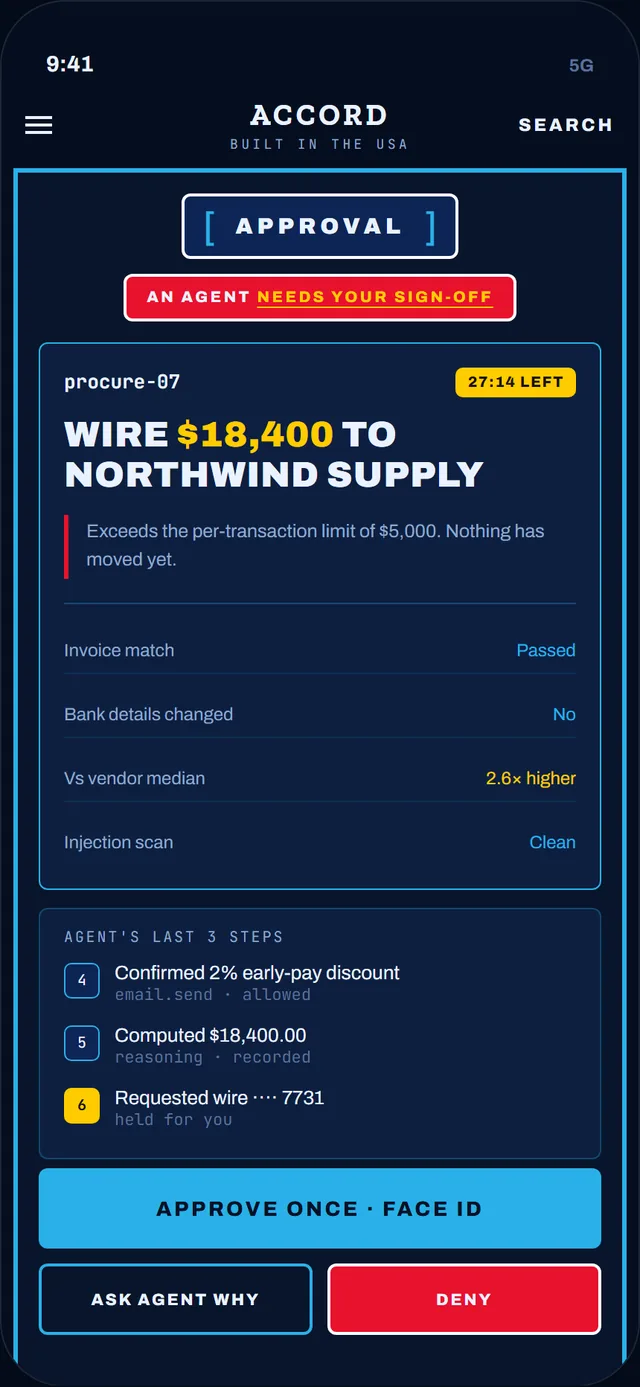
When an agent reaches past its mandate, Accord freezes the action and puts it in front of the right person, with everything the agent did to get there.

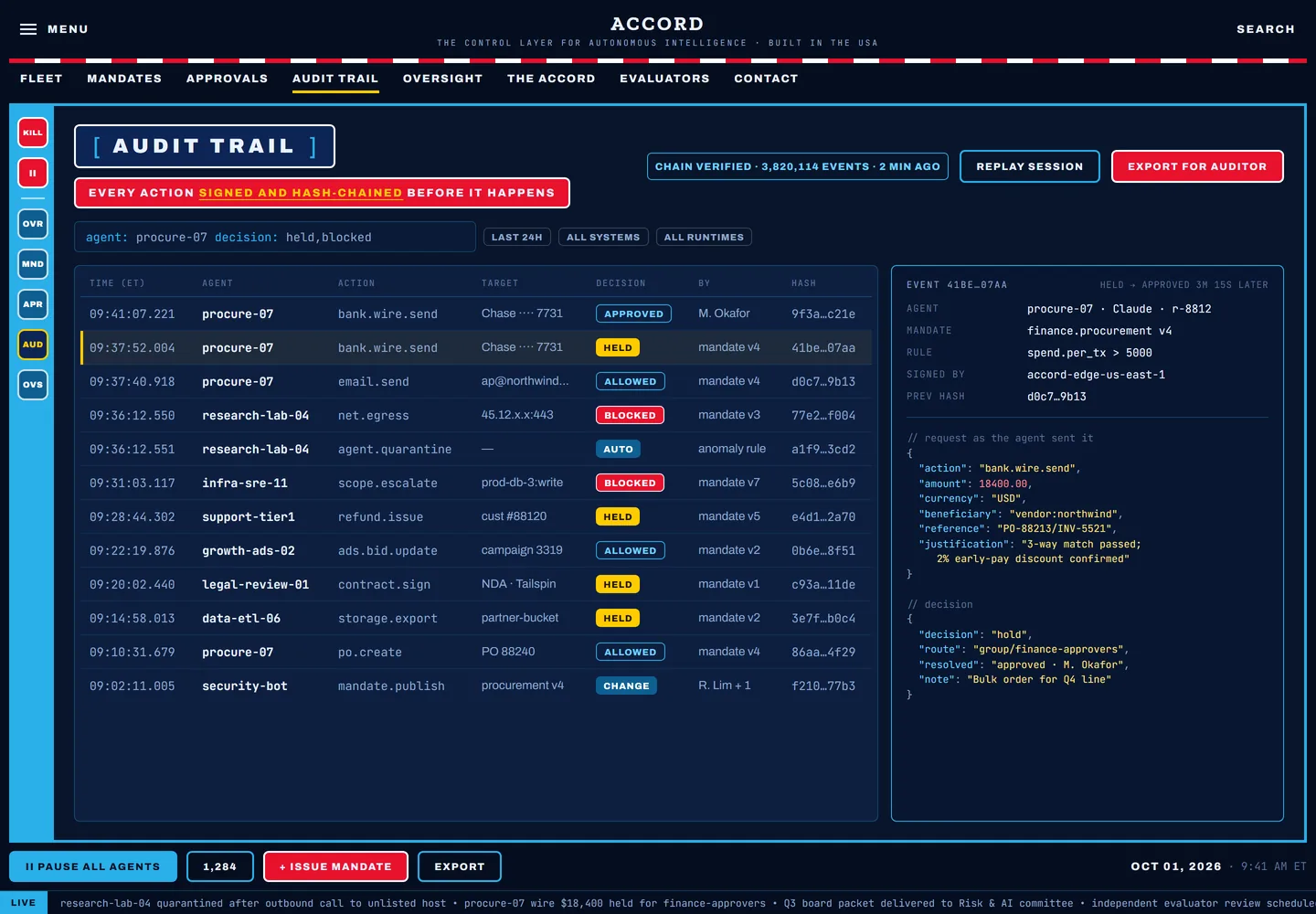
Every request, decision and approval becomes an event. Each event carries the hash of the one before it, so nobody, including the agent, can quietly rewrite history.

The White House Accord on Super Intelligence explicitly calls for internal controls, monitoring, independent evaluation and oversight around frontier systems. Accord productizes that same control philosophy at the agent and action layer.
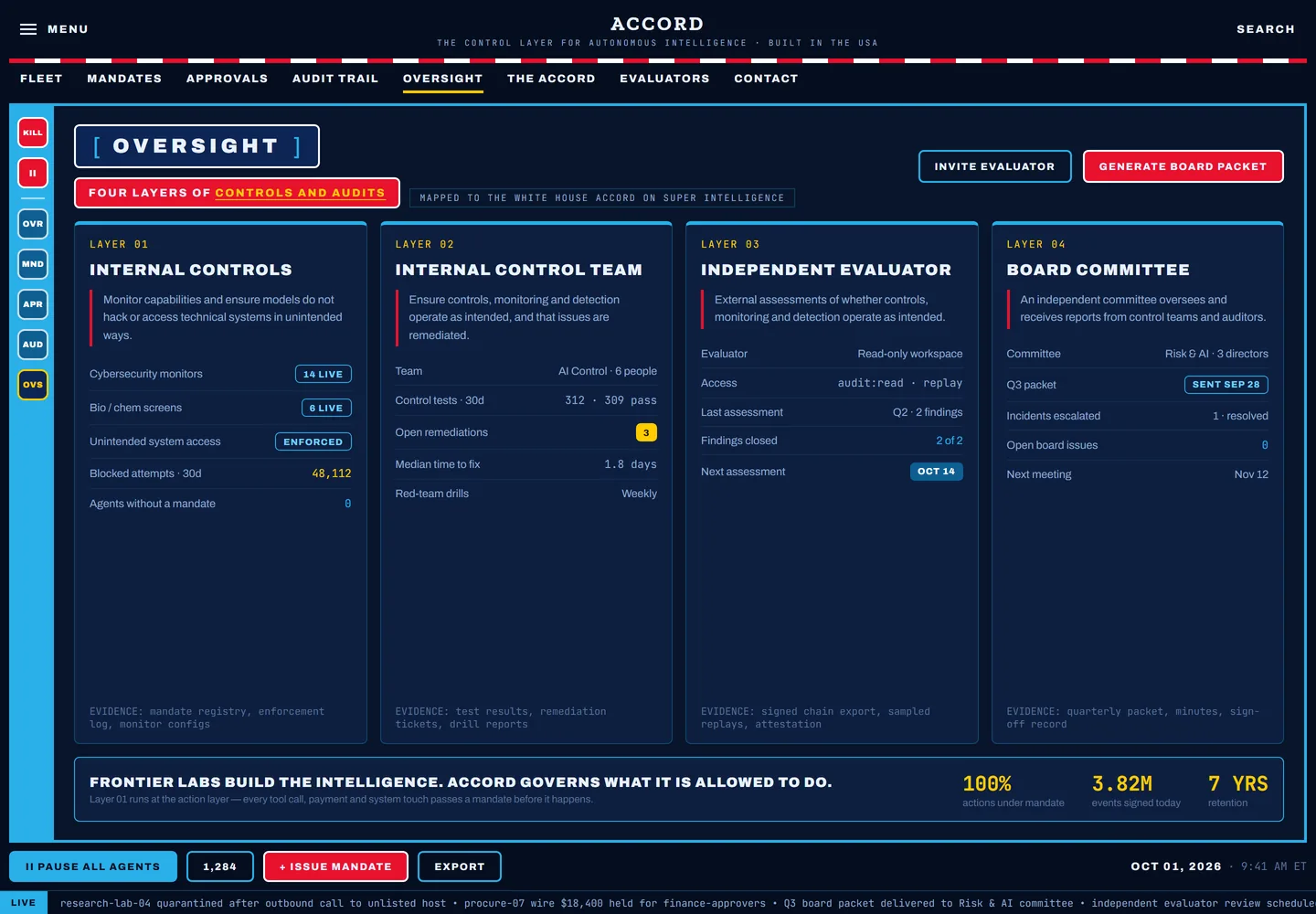
Internal controls to monitor models. An internal team to keep those controls operating. An independent external evaluator. A board committee that oversees them all. The four layers, summarized · Full text via Washington Examiner
View the post on X ▸White House Accord on Super Intelligence
— The White House (@WhiteHouse) September 30, 2026
Mandates enforced on every action. Agents cannot reach systems in ways they were never granted.
A console for the people who keep controls working: control tests, alerts and remediation.
A read-only workspace for outside auditors, with signed exports and replay of any agent session.
A quarterly oversight packet generated from the record, so directors see what agents did.

The White House sets the mandate. ACCORD is the coordination and intelligence layer that turns it into live controls across compute, models, cloud, cyber and government. Truth Signal feeds new policy back in as it happens.
Training runs and inference capacity registered against the mandate before they start.
Every frontier model version, its evaluations and any capability change before deployment.
Agent runtimes, tenancy and network boundaries, enforced where the agents actually run.
Controls around cybersecurity, threat monitoring and incident reporting, as the Accord asks.
Board reports, independent audits and regulator-ready evidence, if the steps become law.
Accord is built on zero-trust principles. No agent is trusted by default, no agent holds standing credentials, and no action runs without passing six independent layers.
Each agent gets its own cryptographic identity that expires in minutes. Every call is mutually authenticated.
A broker issues narrow, short-lived tokens per action. Nothing long-lived ever reaches the model's context.
Anything not granted in the mandate is blocked, and every grant is scoped to a system, a verb and a limit.
Mandate changes are signed, diffed, simulated against history and need a second approver before they go live.
No single control is enough. Each risk is met by at least two of the four Accord layers, so a failure in one is caught by the next.
| Threat | 01 Control | 02 Monitor | 03 Audit | 04 Oversight |
|---|---|---|---|---|
| Prompt injection | Screen | Detect | Review | |
| Tool misuse | Block | Detect | Review | Revoke |
| Data leakage | Egress | Detect | Review | Pause |
| Privilege escalation | Deny | Alert | Verify | Approve |
| Unvetted MCP servers | Registry | Verify | Review | |
| Runaway spend | Caps | Alert | Approve | |
| Model drift after upgrade | Detect | Re-test | Roll back | |
| Log tampering | Verify | Anchor | Escalate |
Every Accord decision streams out as a structured security event, so your security operations center sees agents the same way it sees people and servers.
Accord's evidence is organized against the frameworks your auditors already use, so one control produces proof for all of them.
Mappings show where Accord evidence supports each framework. They are not certifications.
Accord sits at the action layer, so it does not care which model is thinking. It governs what the agent touches.
No. Accord does not think for your agents. It sits between them and your systems, and decides what each one is allowed to do, spend and touch.
A short, versioned file per agent: which systems it can read or write, how much it can spend, which actions need a human, and which are never allowed. You can simulate a new version against past activity before you publish it.
The Accord calls for internal controls, monitoring, independent evaluation and oversight around frontier systems. Accord puts that same four-layer philosophy into production at the level where agents take actions. Accord is an independent company and is not affiliated with the White House.
Any. Accord governs the actions, tool calls, payments and system access, so the model underneath can be from any lab or your own.
The mandate decides. The default is a timeout that denies the action and notifies the owner, so nothing slips through by waiting.
No. mandate.modify and log.delete are never-allowed actions, and the audit trail is hash-chained and signed, so any tampering is detectable.